
Should your child try abacus? Depending on the class and what it claims, it may seem confusing. In this post, we explain the benefits of abacus for children and factors affecting them.
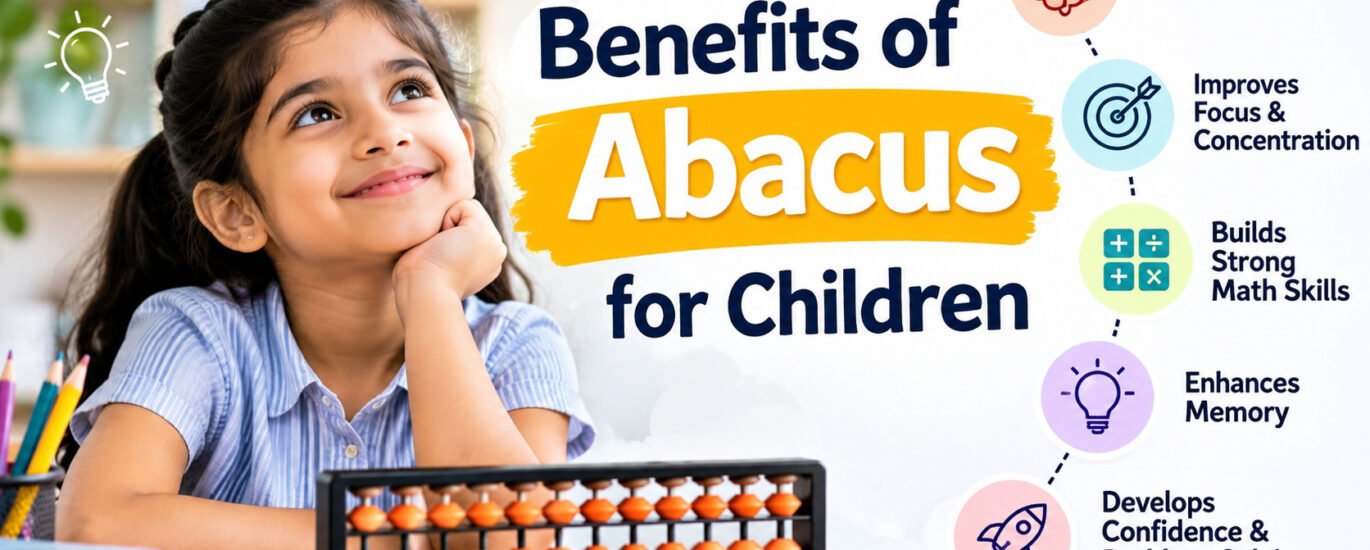
Benefits of Abacus for Children
Improved Number Understanding
As children move beads around to represent numbers, they will understand more about numbers in relation to each other (such as knowing 10 can be made of 1 ten and 0 ones, and 7 can be made up of 5 + 2). This can help in maths at school.
Faster Accurate Calculations
Children will be able to perform addition and subtraction, and further multiplication and division quickly. This is due to gaining an understanding and improving fluency.
Increased Concentration
To complete abacus calculations, children must be focused. Many children can focus for longer periods of time.
Improved Visualisation Skills
benefits of abacus for children In mental abacus, children are asked to visualise the abacus. This creates a pattern of visualising problems, which can help in maths and other subjects.
Improved Memory
As children complete mental calculations, they must hold numbers and bead placements in their minds. Therefore, working memory is improved.
Increased Confidence in Maths
With quick and accurate answers, children will gain more confidence. This can reduce anxiety in maths, especially in children who feel they are ‘bad’ at maths.
Fun Practical Learning
Many children enjoy using the abacus as it involves practical elements. The practical element makes learning seem like a game, meaning younger children may be engaged with it more.
What research shows?
benefits of abacus for children Much research has been done on abacus learning. In it, many people found improvements in mathematical skills and number understanding. However, it is unclear whether there were improvements in other areas, including overall intelligence. The benefits depend on many factors listed below:
- Quality of teaching
- Regular practice
- Age of child and interest
- Understanding has been developed before quickness.
benefits of abacus for children So, in summary, abacus can be a great tool for improving mathematical ability, concentration and confidence in children, as long as it is of high quality and regularly practiced.
Abacus Misconceptions
| Misconception | Fact |
|---|---|
| Your child’s IQ will increase | There is no firm evidence to support this. Abacus can improve mathematical skills and concentration, but not IQ. |
| In just 3 months your child will be a maths whizz! | Improvements will take long periods of regular practice. Progress varies per individual. |
| Abacus should replace maths at school. | Abacus works best when used in conjunction with school maths. |
| All children will enjoy it. | Some children will and some won’t. It depends on the child’s interest. |
| The quicker, the better. | Understanding should be developed first to allow quicker calculations. |
| Younger is always better. | Children must be able to count, and concentrate before beginning abacus. |
Benefits of Abacus at Different Ages
| Age | Likely Benefits |
|---|---|
| 5-6 years Old | Improved counting skills, number recognition, fine motor skills |
| 7-8 years Old | Faster addition/subtraction, improved understanding of place value, beginning to visualise. |
| 9-11 years Old | Mental calculations, multiplication/division, improved concentration in long tasks. |
| 12+ years Old | Speed and accuracy in mental maths, increased confidence in performing calculations. |
Fine motor skills in fingers and hands will also improve as children perform precise movements using the abacus.
Benefits of Abacus in School
- Improved understanding of place value (ones, tens, hundreds)
- Faster addition and subtraction with less stress
- Careful checking of answers
- Quicker mental math questions in exams.
However, the abacus does not directly improve word problems, geometry, and many other areas of maths. To improve in these areas, regular school maths practice is needed. As word problems rely on being able to read, reading skills are also important.
How to Know If Your Child is Benefiting
You may see benefits after a few months.
- Your child can confidently read and represent numbers on the abacus.
- Calculations are quicker and more accurate.
- Less maths anxiety.
- Slightly increased concentration during practice.
- Can explain how they reached an answer.
- More improved number work noticed by teachers.
If no improvements have been seen after several months of regular practice, enquire with the teacher about the speed, difficulty, and methods being used.
Ways to Maximise Benefits from Abacus
- Practise regularly (10-15 mins). Shorter regular sessions are better than long, infrequent sessions.
- Build understanding first. Don’t encourage speed until understanding is achieved.
- Praise effort and accuracy, not speed.
- Play games. You can play bingo, flash cards, or story problems to make it enjoyable.
- Have a set location for the abacus. This encourages a routine.
- Get in contact with the teacher to see how your child is doing.
- Be patient. Skills will develop gradually.
Sample Weekly Routine:
- Monday: Recap the lesson with 5-10 questions.
- Tuesday: Complete a worksheet focusing on accuracy.
- Wednesday: Quick speed test.
- Thursday: Play games (number bingo/flash cards).
- Friday: Complete a worksheet and recap.
- Weekend: Light practice or fun maths game.
Things to Consider
In the interest of honesty, here are some things to consider:
- Regular practice is required, or improvements will be limited.
- Mental abacus can become tiring for children. If rushed, some children can become very stressed.
- Some children may not find it enjoyable. If forced, they may begin to become negative towards maths.
- Quality can vary. If the teaching quality is poor, or classes are very large, improvement may be limited.
- There may be additional costs. There is a charge, and a separate abacus is required.
Is Abacus Suitable for your Child?
Abacus could be suitable if your child:
- Can count and recognise numbers.
- Likes practical activities.
- Can focus for short periods in a class.
- Needs to gain confidence in numbers.
Abacus may not be suitable for your child (or an alternative may be better) if:
- They are too young to focus.
- They become extremely stressed after just a few weeks.
- They need support in basic maths concepts that may not be covered in abacus alone.
If you are unsure, book a free trial session.
Abacus Compared to Other Methods
| Method | Benefits |
|---|---|
| Abacus | Improved number understanding and mental calculations. |
| Vedic maths | Quick calculation tricks. |
| School maths | Gaining understanding, problem-solving skills, and the full curriculum. |
| Maths games/logic puzzles | Fun and logical thinking. |
These methods do not compete. Many children can benefit from a combination of these methods, depending on age and interest.
Abacus Classes at The Reader Nest
We offer live online classes at The Reader Nest to give children a solid foundation in phonics, reading, English, Hindi, Maths and public speaking. In our Abacus Classes (for children aged 5+), children can improve mental calculation, concentration, memory, and number understanding. These interactive classes are taught by experienced teachers and can be completed at flexible times, to suit families both in India and overseas.
All courses can be tried with a free trial class.
Book free trial via WhatsApp, and enter code TRN10 to get 10% off!
Frequently Asked Questions
What are the benefits of abacus?
Number understanding, faster and accurate calculations, concentration, visualisation, improved memory, and increased confidence in maths.
Is abacus good for children?
Yes, as long as it is of good quality and regularly practised. It is a useful tool, but not a quick fix.
Will abacus increase IQ?
It is unclear. It can help children with calculations and concentration, but results may vary between children.
At what age should children start abacus?
Many courses begin at 5 years old, once children can count and recognise numbers.
How long will it take to see benefits?
Most parents see benefits within a few months of regular practice. However, this may vary depending on the child.
Can abacus help a child struggling with maths?
It can help with number knowledge and confidence. However, if a child is struggling with maths concepts, they may require extra support in maths classes at school.
How long should children practise abacus?
Most children can complete 10-15 minutes per day.
Is abacus better than Vedic maths?
No. Abacus helps children develop number understanding using a physical tool. Vedic maths helps children to quickly calculate. Both can be useful to many children.