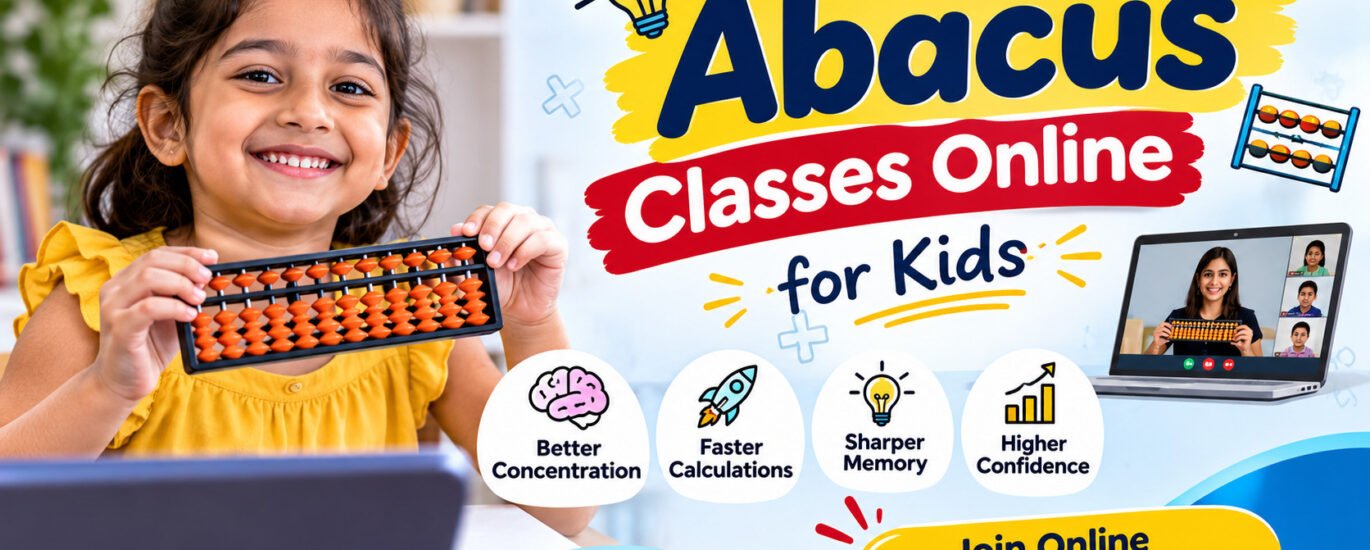
Many parents want their children to gain confidence with numbers. One popular way to do this is through abacus. Now your child can learn using online abacus classes.
Abacus classes online for kids: You’ll find everything you need to know below.
What is an abacus?
An abacus is a simple counting device made up of a frame with rods and beads. Children move beads to demonstrate numbers and perform simple addition and subtraction. More advanced multiplication and division can be learned too.
Most abacus classes use a Japanese-style abacus called a Soroban, with one upper bead and four lower beads on each rod.
How does it work?
Each rod represents a place value (ones, tens, hundreds, etc.). Each bead has a specific value.
| Bead | Value |
|---|---|
| Top Bead (one per rod) | 5 |
| Bottom Beads (four per rod) | 1 each |
Only beads moved towards the middle bar will count. The children will move the beads up and down to demonstrate numbers.
Three stages:
- Physical – Learning how to move the beads for each number and function.
- Imagery – Children will begin to visualise the abacus with the help of the teacher.
- Mental – Using imagery to calculate.
What do children learn?
- Number recognition
- Addition and Subtraction (and multiplication and division later)
- Quick and accurate calculation
- Concentration
- Imagery
- Memory
- Confidence with numbers
Benefits
Children will gain the following from regular practice.
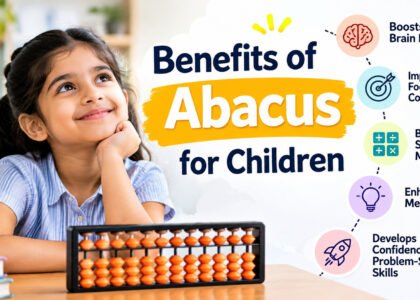
- Improved number sense – By moving beads, children can understand the meaning behind numbers.
- Fast and accurate calculations – Regular practice will help increase speed with fundamental calculations.
- Improved concentration – Tasks require concentration.
- Imagination and memory – When calculating mentally, children work on visualisation.
- Increased confidence with maths – As they achieve small milestones, they will feel less intimidated by maths.
- Hands-on and fun – Many children enjoy Learning Using beads.
Whilst abacus will help children with their calculation skills and concentration, it isn’t a miracle cure. It will depend on the child, teaching and practice.
What age should my child start?
Many abacus programmes begin around the age of 5, when children can count. Usually, children between 5-8 will begin with the physical abacus. Older children will start working on mental calculations.
| Age | Expectations |
|---|---|
| 5-6 years | Counting, number recognition, moving beads, basic addition. |
| 7-8 years | Fast addition and subtraction, beginning to use imagery. |
| 9-11 years | Multiplication and division, mental calculations. |
| 12+ years | Advanced mental maths, increasing speed. |
Younger children will require shorter lessons with lots of fun. If your child isn’t interested in numbers yet, there is no problem in waiting.
How do online abacus classes work?
During live online lessons, the teacher will demonstrate each step on screen.
Typically, lessons will include:
- Warm-up – A quick recap of the previous lesson.
- New Concept – The teacher will explain and demonstrate how to move the beads for a new concept.
- Guided Practice – Children will complete examples.
- Activity / Game – Fun activity to practise speed and accuracy.
- Homework – A short worksheet.
As the lessons are live, the teacher will be able to see how your child is moving their beads and provide instant feedback.
What do you need?
- Physical abacus – This may depend on what type your class recommends.
- Device – Laptop, tablet, or phone with a good internet connection.
- Quiet and well-lit space with a flat surface.
- Paper and pen.
- Parent nearby (if younger).
Check with your class whether they provide an abacus.
Levels
Different institutes may have different names for the levels, but generally:
| Level | What they learn |
|---|---|
| Beginner | Moving beads, representing numbers, basic addition and subtraction. |
| Intermediate | Increasing speed, larger numbers, introduction to multiplication and division. |
| Advanced | Mental calculations, increased speed and accuracy, complex problems. |
Ask your class how many levels they have and how long they usually take.
Online vs In Person
| Online | In Person | |
|---|---|---|
| Travel | No | Yes |
| Flexible timing | Usually Yes | |
| Wide range of teachers | Limited to local area | |
| Hands-on guidance | On screen (with parent help) | Hands on |
| Easy to see parent’s child | Yes | Usually not in the same room |
| Best for | Busy families / Overseas learners | Children who require close attention. |
If your teacher is attentive and you have a small group, then online classes will work well. If your child would benefit from plenty of hands-on help with the beads, then in-person may be a better option.
What to look for in a Good Online Abacus Class?
- Structured Curriculum – Lessons should be clearly laid out and show clear progression.
- Interactive – Children should be actively involved in the lessons and not just watching videos.
- Qualified teachers – Especially with younger children.
- Small group – The teacher should be able to see how your child is moving their beads.
- Balanced – Lessons shouldn’t focus too much on speed.
- Parental feedback – You should be given regular feedback on how your child is doing.
- Practice – Weekly worksheets.
- Free demo – Best way to see if your child enjoys it.
- Clear – Fees, timings, and policies should be easy to find.
Questions to ask:
- What age and level will my child start at?
- How many children are in a group?
- How long are the lessons, and how many per week?
- How many levels are there, and how long do they take?
- Will I need to purchase an abacus?
- How will I know how my child is doing?
- Do they offer a free demo?
- What happens if my child misses a lesson?
- What is the refund/cancellation policy?
Red flags:
- Claims it will increase your child’s IQ or make them a genius in 3 months.
- Only videos with no interactivity.
- Large groups where the teacher can’t see each child.
- No demo.
- Pressuring you to buy lots of levels.
- Unclear fees/policies.
Tips for helping your child get the most out of abacus:
- Practice for 10-15 minutes daily. Short regular practice works best.
- Have a set space for the abacus so it becomes a routine.
- Don’t rush! Focus on understanding.
- Praise for effort and accuracy.
- Celebrate little wins with stickers or a progress chart.
- Keep in contact with the teacher.
A simple weekly plan:
- Monday – Recap what was learnt in class (5-10 sums).
- Tuesday – Practice sheet (focus on accuracy).
- Wednesday – Short speed practice with a timer.
- Thursday – Game, e.g., number bingo or flashcards.
- Friday – Practice sheet and recap.
- Saturday/Sunday – Light practice or fun maths game.
Fun ideas to help your child enjoy abacus:
- Race – Have a gentle race against the clock to display numbers.
- Flash cards – Show your child a number and ask them to show it on the abacus.
- Bingo – Create a bingo card with answers. Call out sums.
- Story Sums – Riya had 7 mangoes. She ate 3. How many are left?
- Teach parent – Let your child teach you how to use the abacus.
- Mental maths games – Quick-fire sums in the car or during meals.
Common mistakes parents make:
- Too much focus on speed.
- Comparison to other children.
- Expecting instant results.
- Not practicing daily and cramming before tests.
- Choosing a class based purely on cost or big claims.
- Pushing a very young child.
Abacus and School Maths
Abacus can help with maths at school by improving number sense and speed. However, it works best as a supplement to school maths. If your child is struggling with word problems or concepts, then extra help may be needed in those areas. Reading skills are important too, as they need to understand the question.
When abacus may not be the best option:
- Your child is very stressed after a few weeks.
- Too young to concentrate.
- Needs help with fundamental maths concepts.
Talk to your child’s teacher and consider a general maths programme to build concepts.
Abacus Classes at The Reader Nest
Our live online programmes at The Reader Nest help children develop a strong foundation in phonics, reading, English, Hindi, maths and public speaking. Our Abacus Classes (age 5+) help children improve their mental maths, concentration, memory, and number skills. Lessons are interactive and taught by experienced educators. We offer flexible timings to suit busy families in India and overseas.
All courses include a free demo.
Book your free demo via WhatsApp using the code TRN10 for 10% off.
FAQ
What are online abacus classes for kids?
Live video lessons where the teacher will show children how to use an abacus for calculations. Later, they will learn how to do mental maths using imagery.
At what age can children start abacus?
Many will start around the age of 5, when they can count.
Are online abacus classes effective?
Yes, if they are live, interactive, and your child practices regularly. It will depend on the child.
Does abacus really help with concentration and memory?
Yes, as they need to concentrate and visualise during regular practice, many children will show improved concentration and number skills. It’s not a guaranteed solution and will depend on the child and practice.
Do I need to purchase an abacus?
Usually yes. Ask your class what type they recommend and if it’s included within the fees.
How long will it take to complete levels?
This will depend on the programme, age of child, and practice. Ask your class how long each level usually takes.
Is abacus better than Vedic maths?
They are completely different. Abacus helps to improve number sense and mental maths with a visual aid. Vedic maths teaches shortcuts to calculations. Many children will benefit from both depending on their age and interests.
How much practice should my child do?
Around 10-15 mins a day is a good target for most children. Short regular practice works best. Many parents want their children to gain confidence with numbers. One popular way to do this is through an abacus. Now your child can learn using online abacus classes.
You’ll find everything you need to know below.
What is an abacus?
An abacus is a simple counting device made up of a frame with rods and beads. Children move beads to demonstrate numbers and perform simple addition and subtraction. More advanced multiplication and division can be learned too.
Most abacus classes use a Japanese-style abacus called a Soroban, with one upper bead and four lower beads on each rod.
How does it work?
Each rod represents a place value (ones, tens, hundreds, etc.). Each bead has a specific value.
| Bead | Value |
|---|---|
| Top Bead (one per rod) | 5 |
| Bottom Beads (four per rod) | 1 each |
Only beads moved towards the middle bar will count. The children will move the beads up and down to demonstrate numbers.
Three stages:
- Physical – Learning how to move the beads for each number and function.
- Imagery – Children will begin to visualise the abacus with the help of the teacher.
- Mental – Using imagery to calculate.
What do children learn?
- Number recognition
- Addition and Subtraction (and multiplication and division later)
- Quick and accurate calculation
- Concentration
- Imagery
- Memory
- Confidence with numbers
Benefits
Children will gain the following from regular practice.
- Improved number sense – By moving beads, children can understand the meaning behind numbers.
- Fast and accurate calculations – Regular practice will help increase speed with fundamental calculations.
- Improved concentration – Tasks require concentration.
- Imagination and memory – When calculating mentally, children work on visualisation.
- Increased confidence with maths – As they achieve small milestones, they will feel less intimidated by maths.
- Hands-on and fun – Many children enjoy Learning Using beads.
Whilst abacus will help children with their calculation skills and concentration, it isn’t a miracle cure. It will depend on the child, teaching and practice.
What age should my child start?
Many abacus programmes begin around the age of 5, when children can count. Usually, children between 5-8 will begin with the physical abacus. Older children will start working on mental calculations.
| Age | Expectations |
|---|---|
| 5-6 years | Counting, number recognition, moving beads, basic addition. |
| 7-8 years | Fast addition and subtraction, beginning to use imagery. |
| 9-11 years | Multiplication and division, mental calculations. |
| 12+ years | Advanced mental maths, increasing speed. |
Younger children will require shorter lessons with lots of fun. If your child isn’t interested in numbers yet, there is no problem in waiting.
How do online abacus classes work?
During live online lessons, the teacher will demonstrate each step on screen.
Typically, lessons will include:
- Warm-up – A quick recap of the previous lesson.
- New Concept – The teacher will explain and demonstrate how to move the beads for a new concept.
- Guided Practice – Children will complete examples.
- Activity / Game – Fun activity to practise speed and accuracy.
- Homework – A short worksheet.
As the lessons are live, the teacher will be able to see how your child is moving their beads and provide instant feedback.
What do you need?
- Physical abacus – This may depend on what type your class recommends.
- Device – Laptop, tablet, or phone with a good internet connection.
- Quiet and well-lit space with a flat surface.
- Paper and pen.
- Parent nearby (if younger).
Check with your class whether they provide an abacus.
Levels
Different institutes may have different names for the levels, but generally:
| Level | What they learn |
|---|---|
| Beginner | Moving beads, representing numbers, basic addition and subtraction. |
| Intermediate | Increasing speed, larger numbers, introduction to multiplication and division. |
| Advanced | Mental calculations, increased speed and accuracy, complex problems. |
Ask your class how many levels they have and how long they usually take.
Online vs In Person
| Online | In Person | |
|---|---|---|
| Travel | No | Yes |
| Flexible timing | Usually Yes | |
| Wide range of teachers | Limited to local area | |
| Hands-on guidance | On screen (with parent help) | Hands on |
| Easy to see parent’s child | Yes | Usually not in the same room |
| Best for | Busy families / Overseas learners | Children who require close attention. |
If your teacher is attentive and you have a small group, then online classes will work well. If your child would benefit from plenty of hands-on help with the beads, then in-person may be a better option.
What to look for in a Good Online Abacus Class?
- Structured Curriculum – Lessons should be clearly laid out and show clear progression.
- Interactive – Children should be actively involved in the lessons and not just watching videos.
- Qualified teachers – Especially with younger children.
- Small group – The teacher should be able to see how your child is moving their beads.
- Balanced – Lessons shouldn’t focus too much on speed.
- Parental feedback – You should be given regular feedback on how your child is doing.
- Practice – Weekly worksheets.
- Free demo – Best way to see if your child enjoys it.
- Clear – Fees, timings, and policies should be easy to find.
Questions to ask:
- What age and level will my child start at?
- How many children are in a group?
- How long are the lessons and how many per week?
- How many levels are there, and how long do they take?
- Will I need to purchase an abacus?
- How will I know how my child is doing?
- Do they offer a free demo?
- What happens if my child misses a lesson?
- What is the refund/cancellation policy?
Red flags:
- Claims it will increase your child’s IQ or make them a genius in 3 months.
- Only videos with no interactivity.
- Large groups where the teacher can’t see each child.
- No demo.
- Pressuring you to buy lots of levels.
- Unclear fees/policies.
Tips for helping your child get the most out of abacus:
- Practice for 10-15 minutes daily. Short regular practice works best.
- Have a set space for the abacus so it becomes a routine.
- Don’t rush! Focus on understanding.
- Praise for effort and accuracy.
- Celebrate little wins with stickers or a progress chart.
- Keep in contact with the teacher.
A simple weekly plan:
- Monday – Recap what was learnt in class (5-10 sums).
- Tuesday – Practice sheet (focus on accuracy).
- Wednesday – Short speed practice with a timer.
- Thursday – Game, e.g., number bingo or flashcards.
- Friday – Practice sheet and recap.
- Saturday/Sunday – Light practice or fun maths game.
Fun ideas to help your child enjoy abacus:
- Race – Have a gentle race against the clock to display numbers.
- Flash cards – Show your child a number and ask them to show it on the abacus.
- Bingo – Create a bingo card with answers. Call out sums.
- Story Sums – Riya had 7 mangoes. She ate 3. How many are left?
- Teach parent – Let your child teach you how to use the abacus.
- Mental maths games – Quick-fire sums in the car or during meals.
Common mistakes parents make:
- Too much focus on speed.
- Comparison to other children.
- Expecting instant results.
- Not practicing daily and cramming before tests.
- Choosing a class based purely on cost or big claims.
- Pushing a very young child.
Abacus and School Maths
Abacus can help with maths at school by improving number sense and speed. However, it works best as a supplement to school maths. If your child is struggling with word problems or concepts, then extra help may be needed in those areas. Reading skills are important too, as they need to understand the question.
When abacus may not be the best option:
- Your child is very stressed after a few weeks.
- Too young to concentrate.
- Needs help with fundamental maths concepts.
Talk to your child’s teacher and consider a general maths programme to build concepts.
Abacus Classes at The Reader Nest
Our live online programmes at The Reader Nest help children develop a strong foundation in phonics, reading, English, Hindi, maths and public speaking. Our Abacus Classes (age 5+) help children improve their mental maths, concentration, memory, and number skills. Lessons are interactive and taught by experienced educators. We offer flexible timings to suit busy families in India and overseas.
All courses include a free demo.
Book your free demo via WhatsApp using the code TRN10 for 10% off.
FAQ
What are online abacus classes for kids?
Live video lessons where the teacher will show children how to use an abacus for calculations. Later, they will learn how to do mental maths using imagery.
At what age can children start abacus?
Many will start around the age of 5 when they can count.
Are online abacus classes effective?
Yes, if they are live, interactive, and your child practices regularly. It will depend on the child.
Does abacus really help with concentration and memory?
Yes, as they need to concentrate and visualise during regular practice, many children will show improved concentration and number skills. It’s not a guaranteed solution and will depend on the child and practice.
Do I need to purchase an abacus?
Usually yes. Ask your class what type they recommend and if it’s included within the fees.
How long will it take to complete levels?
This will depend on the programme, age of the child, and practice. Ask your class how long each level usually takes.
Is abacus better than Vedic maths?
They are completely different. Abacus helps to improve number sense and mental maths with a visual aid. Vedic maths teaches shortcuts to calculations. Many children will benefit from both depending on their age and interests.
How much practice should my child do?
Around 10-15 mins a day is a good target for most children. Short, regular practice works best.