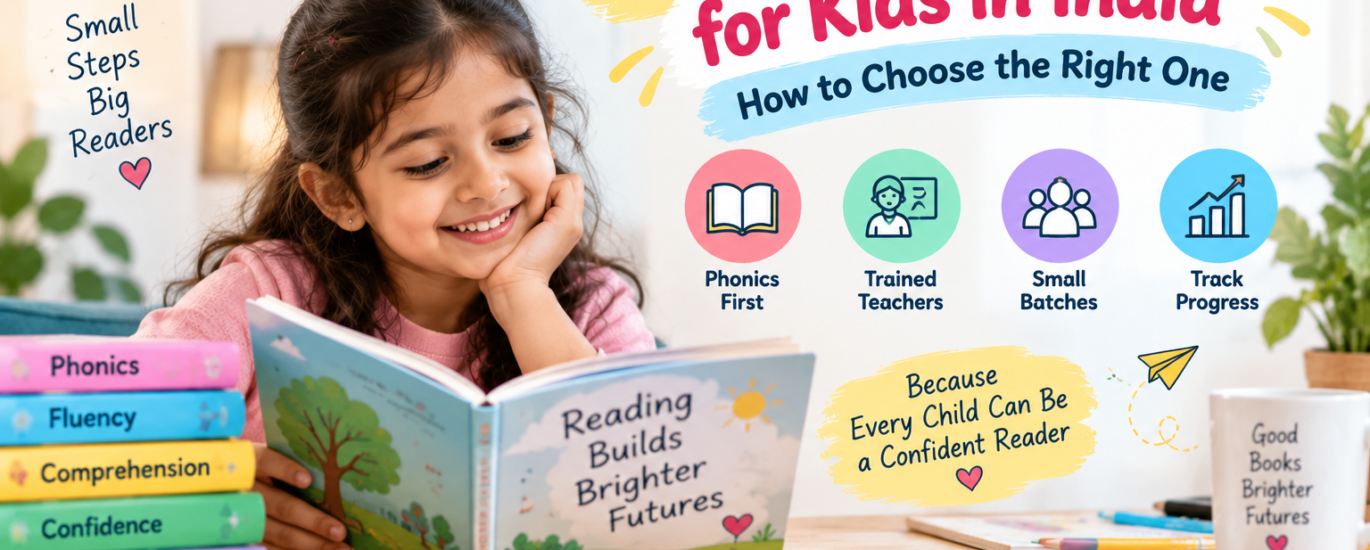
Search “best reading program for kids India” and you’ll get dozens of options claiming to be the one your child needs. Some are genuinely good. A lot are just marketing. The tricky part for most parents isn’t finding a program — it’s figuring out which one will actually move the needle for their child.
Why “best” depends on your child, not a ranking
There’s no single program that works best for every kid. A 4-year-old just learning letter sounds needs something completely different from an 8-year-old who reads but struggles with comprehension. Before shortlisting anything, it helps to know exactly where your child is stuck — decoding words, reading fluently, understanding what they’ve read, or simply staying interested in books at all.
What separates a genuinely good reading program from an average one
A strong program builds on phonics first — teaching kids to connect sounds to letters so they can decode new words instead of memorizing them. From there, it should move naturally into fluency and comprehension, not jump straight to “read this story and answer questions.”
Beyond the curriculum, a few practical things matter just as much:
The teacher matters more than the platform. A trained instructor who can adjust on the fly beats a fixed video course every time. Batch size matters too — six kids in a class get far more attention than twenty. And you want some way to actually track progress, not just a certificate at the end that doesn’t tell you much.
Online vs. offline: what actually works in the Indian context
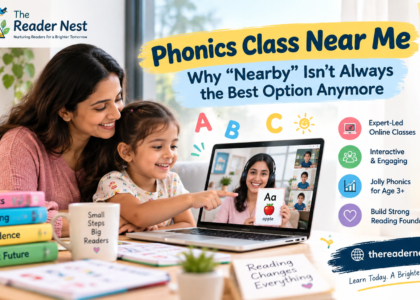
For families outside major cities, or with packed school schedules, online reading programs have become the practical choice — not because they’re inherently better, but because access to a genuinely good reading tutor nearby is rare. A well-run online class with live instruction can match, and sometimes beat, what’s available locally, simply because it isn’t limited by geography.
That said, online only works if the program keeps kids actively engaged — interactive sessions, real conversation with the teacher, not passive video-watching.
Red flags worth watching for
A few signs a program might not be worth the money: no clear structure or curriculum you can see in advance, huge class sizes marketed as “personalized,” no way to track whether your child is actually improving, or content that’s clearly translated/adapted from a generic template rather than built for how Indian kids learn English.
Where to start
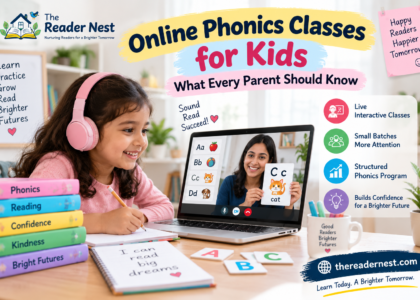
If your child is behind on reading, avoiding books, or just needs a stronger foundation than school alone is giving them, a structured, phonics-first reading program — taught live, in small groups — is usually the most reliable starting point.
The Reader Nest offers exactly this kind of structured online reading program for kids, built around live instruction and real progress tracking rather than one-size-fits-all content.