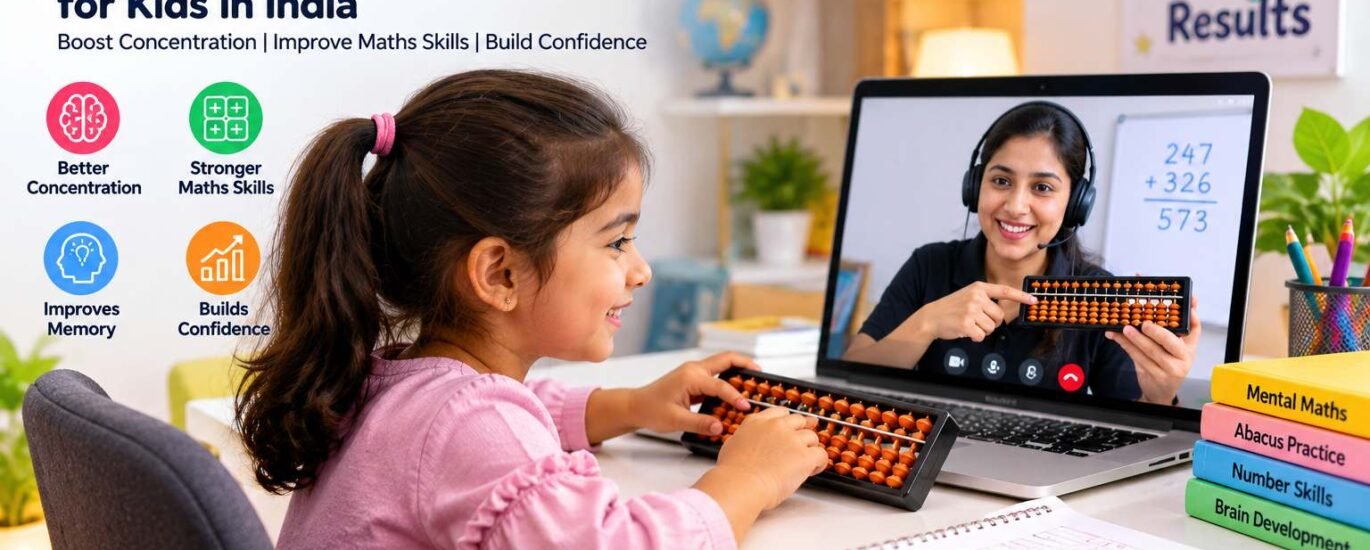
Many Indian parents hear about abacus from a neighbour or a relative whose child can add six-digit numbers in their head. It sounds impressive, and it raises an obvious question: is it worth it for my child? If you are looking at abacus classes online for kids India now offers, you will find plenty of options, and it is easy to feel lost. This guide explains what abacus really teaches, when to start, how online classes work and what to check before you sign up.
What Abacus Is and How Children Learn It
An abacus is a counting tool with rows of beads that stand for ones, fives, tens and so on. It has been used for centuries in many parts of the world, and you can read more about its history on this overview of the abacus. In modern kids’ classes, children first learn to move the beads with their fingers to add, subtract, multiply and divide. Once that feels natural, they are taught to picture the abacus in their mind and calculate without the physical tool. This second stage is called mental abacus, and it is where most of the speed and concentration benefits are said to appear.
What Children Can Gain
Abacus is not magic, and no class can promise a particular result. But when a child practises regularly, several useful habits tend to develop. Number sense improves, because children see how numbers combine and split rather than memorising tables. Concentration grows, since moving beads and visualising them needs focus. Memory gets exercise through holding numbers in the mind. Many children also become more confident with maths because calculation starts to feel easy, and that confidence often carries into school. Research on abacus training has produced mixed findings, so treat it as a good practice routine for mental calculation, not a guaranteed way to raise grades.
The Right Age to Start
Most programmes start around age five or six, once a child can recognise numbers and use their fingers with some control. Starting earlier is possible if the teaching is playful, but forcing a very young child through drills can backfire. The Reader Nest, for instance, offers Abacus classes for children from five years onwards. Older children can join too, because the early levels are the same, and a nine- or ten-year-old often moves through them faster. What matters more than age is willingness to practise a little every day.
How Online Abacus Classes Work
Online classes use a video call, a virtual or physical abacus and a teacher who guides the child through each level. The child keeps a physical abacus at home and follows the teacher on screen, while the teacher watches finger movements on camera and corrects them. Many programmes also use worksheets, flashcards and short quizzes, along with a screen-sharing tool for practice problems. The main advantage is convenience. There is no travel, timings can be flexible, and children can learn from a teacher in another city, which is especially useful for families abroad. The trade-off is that the child needs a stable internet connection, a quiet corner and a parent nearby for younger kids.
What to Look for in a Good Programme
Not all classes are equal, so ask a few specific questions before enrolling. Is the course divided into clear levels, and how long does each level take? Are classes live with a teacher, or mostly recorded videos? A live teacher can fix a wrong finger position straight away, which matters a great deal in the early weeks. What is the batch size? Smaller groups give each child more attention. How is progress measured, and will you receive regular updates? Is there a demo class? A good programme will let your child try one lesson before you commit, and will tell you honestly if abacus does not suit your child’s age or interest.
Be wary of any claim that sounds too big, such as guaranteed top ranks or dramatic IQ jumps. Learning abacus builds a skill, and the benefits come from steady practice over months, not from a few weeks of classes.
How Parents Can Help at Home
Your involvement makes a big difference. Set a fixed practice time, even if it is only fifteen minutes a day, and keep the abacus in a visible place. Sit with your child during the first few weeks and ask them to show you how a bead movement works. Praise effort instead of speed, because rushing early on leads to mistakes that are hard to unlearn. Avoid comparing your child with others. Some children take to mental visualisation quickly, while others need more time, and both are normal.
How Abacus Fits with Other Learning
Abacus is one part of a child’s learning. Reading and language skills matter just as much for school success, so it helps to build both together. If your child is also starting to read, you may find our guide to online phonics classes for kids useful. A balanced week that includes reading, number practice and some free play usually works better than one subject done intensively.
Try a Demo Before You Decide
The best way to know whether abacus suits your child is to watch them in a class. Look at whether they stay interested, whether the teacher explains clearly and whether they enjoy the bead work. If you would like to see how it works, you can book a free demo class on WhatsApp and talk to the team about the right level for your child’s age.