If your child guesses at words instead of sounding them out, or forgets a word they read just yesterday, the missing piece is often phonics. It is the skill that turns a child from someone who memorises words into someone who can actually read.
That is why more parents in India are choosing online phonics classes for kids. This guide explains what phonics is, when to start, how online classes work, and how to pick a good one.
What Is Phonics?
Phonics is a method of teaching reading by connecting letters with the sounds they make. Instead of memorising whole words, children learn that the letter “s” makes the /s/ sound, “a” makes /a/, and “t” makes /t/. Then they blend the sounds: s-a-t becomes “sat”.
Once a child knows this, they can read new words on their own. That builds confidence, and confident readers read more.
Why Phonics Matters in the Early Years
- It builds the foundation for reading. Children who understand letter sounds read more fluently later.
- It improves spelling. If a child knows the sounds, they can try to write the word.
- It supports English speaking. Clear sounds lead to clearer pronunciation.
- It reduces frustration. Children stop guessing and start decoding.
What Is the Right Age to Start Phonics?
Most children are ready to begin around 3 to 4 years, when they start recognising letters and enjoying sounds, rhymes and songs. Older children (6 to 8 years) who struggle with reading can also benefit, because phonics fills the gaps in their foundation.
Every child is different. If your child enjoys books, listens to rhymes and shows interest in letters, they are probably ready.
How Do Online Phonics Classes Work?
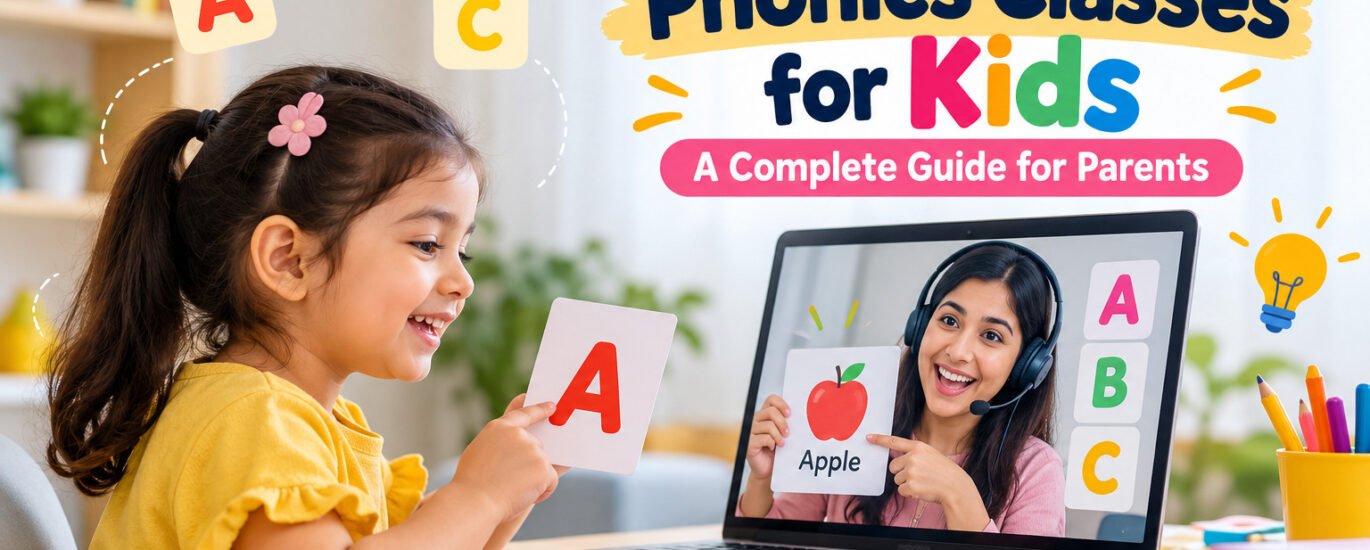
In an online phonics class, a teacher teaches your child live through video, using visuals, games, songs, and activities.
A typical lesson includes:
- Learning a new sound with pictures and actions
- Blending practice to join sounds into words
- Reading simple words and sentences
- Games and activities to keep the child engaged
- Revision of previous sounds
Because classes are live, the teacher can listen to your child, correct pronunciation immediately, and adjust the pace.
Benefits of Online Phonics Classes
Learn from home. No travelling, no fixed centre timings, and your child learns in a comfortable space.
More choice. You are not limited to teachers in your area. This is especially helpful for smaller cities and for NRI families abroad.
Flexible timings. Batches can fit around school and family schedules.
Personal attention. A good online class keeps groups small, so every child gets a chance to speak.
Parents can observe. You can see exactly how your child is being taught and support them at home.
What to Look for in a Good Online Phonics Class
Before enrolling, check these points:
- Structured curriculum. The programme should move step by step, from single sounds to blending, words, and sentences. Jolly Phonics is a popular, well-known approach for young learners.
- Experienced teachers. Teachers should be trained to work with young children and keep them engaged.
- Interactive lessons. Look for songs, actions, games, and stories, not just a teacher talking.
- Small batch size. Your child should get speaking time.
- Regular feedback. You should know how your child is progressing.
- A free demo class. This is the best way to see if your child enjoys the teaching style.
How Parents Can Support Phonics at Home
Classes work best when practice continues at home. Try these simple ideas:
- Spend 10 to 15 minutes a day revising sounds
- Play “I spy” using letter sounds
- Read picture books together every day
- Point out letters on signs, packets, and books
- Praise effort, not just correct answers
Short, regular practice works better than one long session.
Common Mistakes to Avoid
- Rushing the child. Let them master sounds before moving on.
- Teaching only letter names. Sounds matter more for reading.
- Making it feel like a test. Keep it playful.
- Skipping revision. Young children need repetition.
Phonics at The Reader Nest
At The Reader Nest, our Jolly Phonics programme for children aged 3+ builds the first foundations of reading through letters, sounds, blending and simple words. Classes are live, interactive, and led by experienced educators, with flexible timings for families in India and overseas.
Every course begins with a free demo class, so your child can try it before you decide.
[Book Your Free Demo on WhatsApp] | New learners can use code TRN10 for 10% off.
Frequently Asked Questions
Are online phonics classes effective for young children?
Yes, when the classes are live, interactive, and structured. Children respond well to games, songs and a teacher who gives them individual attention.
How long does it take for a child to learn phonics?
It depends on the child’s age and practice, but most children grasp the basic sounds and start blending within a few months of regular classes.
Can my child learn phonics if they are already in school?
Yes. Many school-going children join phonics classes to strengthen reading, spelling, and pronunciation.
How long should a phonics class be for a 4-year-old?
Young children focus best in shorter sessions, so classes with activities and breaks work better than long lectures.
Do I need to sit with my child during the class?
For younger children, a parent nearby helps with setup and focus. As they grow comfortable, they can take part independently.