Every phonics class calls itself “the best.” Bright websites, big promises, a few smiling photos. So how do you actually tell the difference? You compare them on the things that matter. This guide shows you how to judge the best phonics classes for kids using seven points, so your decision rests on facts, not advertising.
Why Comparing Classes Is Worth the Effort
A weak phonics class does more than waste money. It can leave a child confused about sounds and convinced that reading is hard. That’s a costly start. A strong class does the opposite: your child sounds out a word on a signboard one day and can’t stop reading the next.
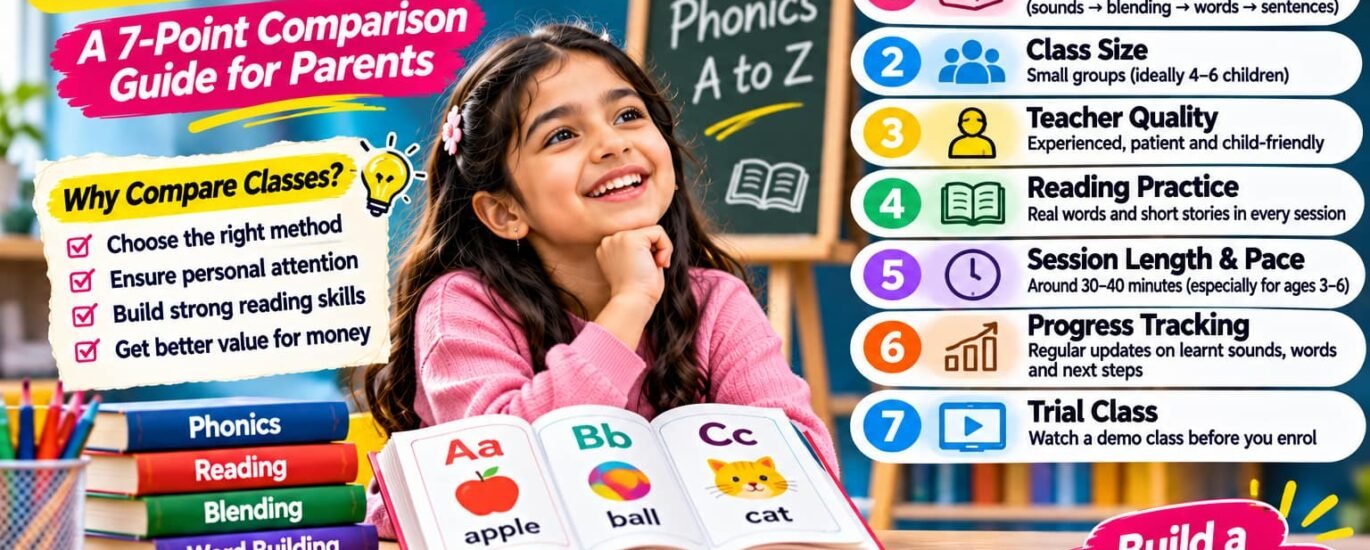
The 7-Point Comparison
1. Teaching Method
Look for a clear order: single letter sounds, then blending, then simple words, then short sentences. For a better understanding of phonics teaching, parents can explore the Reading Rockets guide to phonics and decoding, which explains how children connect letters with sounds to read words.
2. Class Size
Small groups of 4 to 6 children let the teacher hear each child read aloud. In a group of 20, most children just watch.
3. Teacher Quality
Ask about training and experience with young children. Patience matters more than a fancy certificate.
4. Reading Practice
Learning sounds alone isn’t enough. The best phonics classes for kids include real words and short stories in every session.
5. Session Length and Pace
For ages 3 to 6, 30 to 40 minutes works well. Longer sessions tire children out.
6. Progress Tracking
A good class tells you which sounds your child has mastered and what to practise at home.
7. Trial Class
Never pay before you watch a demo. How a teacher handles a mistake tells you everything.
Quick Scorecard
| What to check | Strong sign | Warning sign |
|---|---|---|
| Method | Clear step-by-step plan | Random activities |
| Group size | 4 to 6 children | 15 or more |
| Teacher | Warm and patient | Rushes or scolds |
| Reading practice | Every session | Only worksheets |
| Feedback | Regular updates | Silence after payment |
Give each class a score out of 5 on each point, then add them up.
Online or Offline?
Neither wins automatically. Online classes save travel time and give you more choice of teachers. Offline classes suit children who learn better in a physical group. A well-run online class beats a crowded offline one every time.
What About Fees?
Don’t pick the cheapest or the most expensive by default. Compare what you get for the money: group size, session count, teacher attention and feedback. A slightly higher fee for small groups usually pays off.
3 Mistakes Parents Make
- Choosing by reviews alone. Always watch a trial class yourself.
- Expecting quick results. Most children need months of steady practice.
- Skipping home practice. Ten minutes a day makes a huge difference.
Read More Before You Decide
For free guidance on how phonics works and how to support it at home, the Oxford Owl website is a useful reference for parents.
Where The Reader Nest Fits
If you’d like to include an online option in your comparison, The Reader Nest runs online phonics and reading classes for young children. Visit the site, review the approach and judge it against the seven points above.
Final Verdict
The best phonics classes for kids aren’t the loudest or the cheapest. They’re the ones with a clear method, small groups, patient teachers and honest feedback. Compare at least three, watch a trial and trust what you see.