
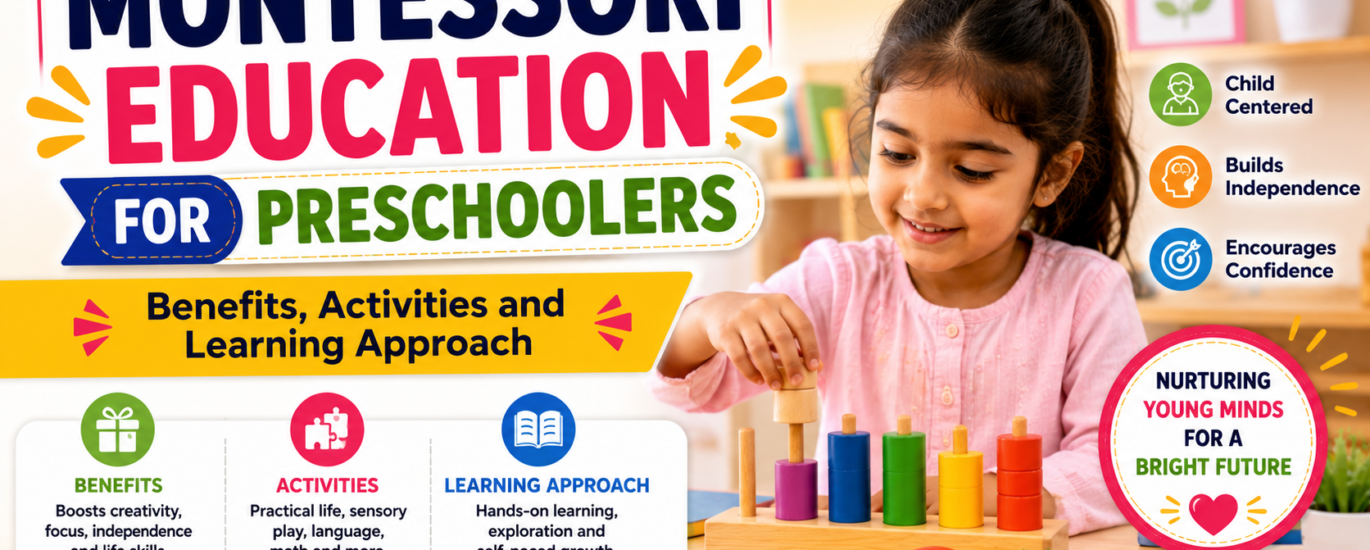
The preschool years are an important stage in a child’s development. During this period, children naturally want to explore, ask questions, experiment and become more independent. Montessori education for preschoolers is designed around this natural curiosity and encourages children to learn through hands-on experiences.
The Reader Nest offers an offline Montessori environment where children can develop early academic, practical, social and communication skills through age-appropriate learning experiences.
What Is Montessori Education?
The Montessori method is a child-centred educational approach developed by Dr. Maria Montessori. It focuses on independence, exploration, practical experiences and learning at the child’s pace.
Instead of relying only on traditional instruction, Montessori environments encourage children to actively participate in their learning.
Key Principles of Montessori Learning
1. Individualised Learning
Every child develops differently. Montessori learning gives children opportunities to work according to their individual pace and interests.
2. Self-Directed Learning
Children are encouraged to choose appropriate activities and take an active role in their learning. This can help develop independence and responsibility.
3. Hands-On Learning
Children learn through specially designed materials and practical activities. These experiences can support fine-motor development, concentration, problem-solving and critical thinking.
4. Prepared Environment
A Montessori classroom is carefully organised so children can access materials and participate in activities independently.
5. Social Development
Children learn to communicate, cooperate, respect others and become responsible members of their learning community.
Montessori Activities for Preschoolers
A Montessori classroom can include a wide range of practical and educational activities.
Practical Life Activities
Children may practise activities such as:
- Pouring
- Spooning
- Buttoning
- Sweeping
- Carrying objects
- Self-care activities
- Caring for the environment
These activities can support coordination, independence and concentration.
Language Development
Language learning is an important part of Montessori education. Children are exposed to rich vocabulary and gradually introduced to phonetics, word building, reading and writing.
Sensorial Activities
Sensorial materials help children explore concepts through their senses. Activities can encourage observation, comparison, classification and careful attention to detail.
Early Mathematics
Montessori mathematics activities introduce children to numbers and mathematical concepts through concrete materials. Children can gradually progress towards operations such as addition, subtraction, multiplication and division.
Cultural Learning
Children can also explore geography, history, science and art through hands-on activities and age-appropriate materials.
The Reader Nest Montessori Programmes
The Reader Nest offers programmes designed for different stages of early childhood.
Little Nestlings — 2.5 to 3.5 Years
This programme is designed to make a child’s transition from home to school gentle and positive.
Children work towards developing:
- Confidence
- Independence
- Communication
- Listening skills
- Concentration
- Fine and gross motor skills
- Social skills
- Emotional expression
Growing Nestlings — 3.5 to 4.5 Years
Growing Nestlings focuses on preparing children for formal schooling while developing curiosity and independence.
Children are introduced to:
- Early reading and phonics
- Number sense
- Logical thinking
- Communication
- Vocabulary
- Creativity
- Problem-solving
- Critical thinking
- Social and emotional development
Why Choose Montessori for Early Learning?
A quality Montessori environment can provide children with opportunities to learn by doing rather than simply listening.
Children can practise independence, concentration, communication and problem-solving while developing early academic foundations.
The objective is to prepare children not only for school but also for everyday life.
Montessori and Parent Involvement
Parents play an important role in early childhood learning. At The Reader Nest, parent communication and updates are part of the learning experience.
Parents can also support Montessori principles at home by allowing children to participate in age-appropriate everyday activities, make simple choices and practise independence.
Final Thoughts
Montessori education for preschoolers can create a strong foundation for lifelong learning by combining independence, exploration, practical activities and child-centred education.
If you are looking for a nurturing Montessori environment for your child, The Reader Nest offers early-learning programmes designed to support children’s academic, social and personal development.