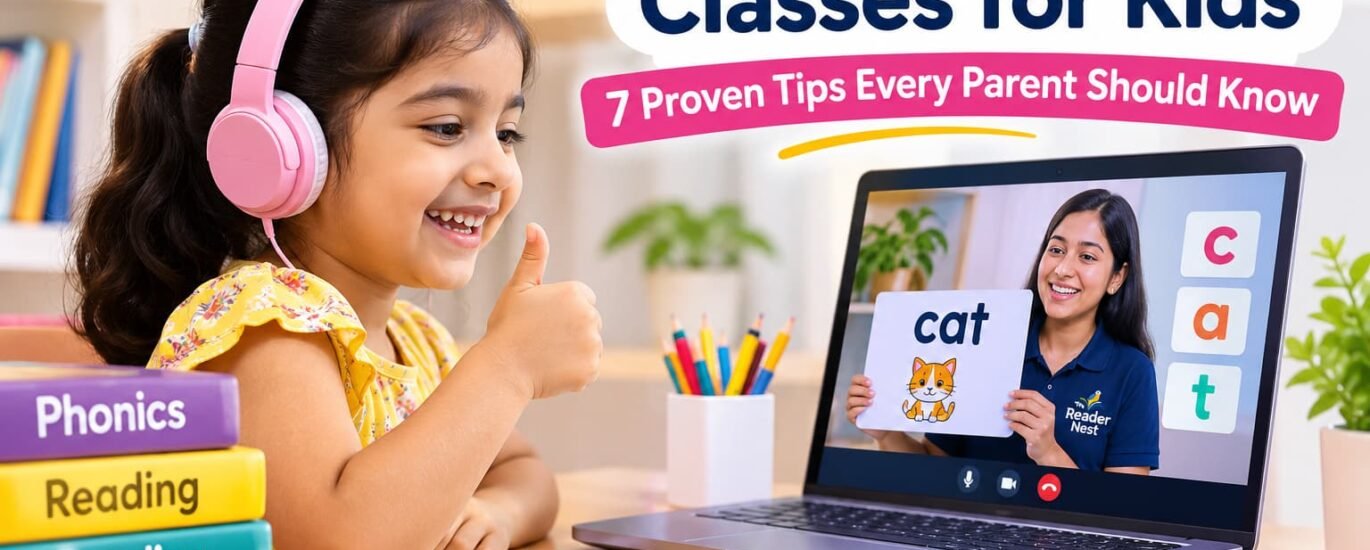
Watching your child struggle with letters is frustrating. They know the alphabet song by heart, yet freeze when they see a simple word on a page. That gap is exactly what phonics is built to close. And today, online phonics classes for kids make good teaching available from your living room. But not every class is worth your money. Here’s how to pick one that actually works.
What Are Online Phonics Classes for Kids?
Phonics teaches children that letters make sounds, and that sounds blend into words. According to Reading Rockets’ guide to phonics and decoding, children learn to connect written letters with spoken sounds to recognise and read words.
In an online class, a trained teacher guides your child through these sounds on a screen, using pictures, games, songs and short reading practice. Most programmes suit children from about 3 to 7 years old, though every child moves at a different pace.
Why Parents Choose Online Phonics Classes
- Convenience. No travel, no traffic, no missed classes in bad weather.
- Wider choice. You can pick from skilled teachers across India, not just one neighbourhood.
- Focused attention. Small groups or one-to-one sessions let teachers spot problems early.
- Safe and comfortable. Your child learns at home, with you nearby.
- Flexible timing. Many classes fit around school hours and family routines.
7 Proven Tips for Choosing the Right Class
1. Check the Teaching Method
Look for a clear, step-by-step approach: single letter sounds first, then blending, then simple words, then short sentences. If a teacher can’t explain their method in two minutes, that’s a red flag.
2. Keep Sessions Short and Lively
For young children, 30 to 40 minutes is plenty. Long, passive sessions drain attention fast. The best classes use songs, actions and games every few minutes.
3. Prefer Small Groups
A class of 4 to 6 children lets the teacher listen to each child read. Large groups turn into lectures, and struggling children get lost.
4. Look for Real Reading Practice
Learning sounds isn’t enough. Your child should read actual words and short stories in every session, and get gentle correction on the spot.
5. Ask for a Trial Class
Watch how the teacher treats mistakes. A patient, warm teacher builds confidence. A harsh one can make a child dread reading for months.
6. Check Progress Updates
Good programmes share simple progress notes: what sounds your child has mastered, which ones need work and what to practise at home.
7. Match Pace to Your Child
A strong class adjusts speed. Some children need extra time on tricky sounds like “sh”, “ch” and “th”, and that’s perfectly normal.
What Your Child Needs for Online Learning
You don’t need fancy equipment. A stable internet connection, a laptop, tablet or large phone, a quiet corner and headphones are enough. Keep sessions at a regular time, so learning becomes a habit. Stay nearby for the first few classes, then step back as your child gains confidence.
5 Costly Mistakes to Avoid
- Choosing only on price. The cheapest class often has the weakest teaching.
- Expecting fast results. Most children need several months of steady practice before reading feels natural.
- Skipping home practice. Ten minutes a day makes a huge difference.
- Comparing your child with others. Every child learns at their own speed.
- Ignoring screen fatigue. If your child looks tired or bored, talk to the teacher and adjust the schedule.
Simple Ways to Support Learning at Home
Play “I spy” using sounds, such as “I spy something starting with /m/.” Read one short story together every night, letting your child point to the words. Sing rhyming songs in the car. Praise effort, not just accuracy: “You worked so hard on that word!” Keep it joyful, never stressful.
How Long Before You See Progress?
Many parents notice small wins within the first few weeks, such as sounding out a word on a shop sign or reading a short line in a picture book. Smooth, confident reading takes longer. Stay patient and keep sessions fun, and progress follows.
Warning Signs of a Poor Class
- No clear teaching plan
- Constant screen time with no interaction
- Pressure, shouting or public embarrassment
- No feedback for parents
- Promises of “fluent reading in 7 days”
If you see any of these, move on quickly. Your child’s confidence is too valuable to risk.
Start Your Child’s Reading Journey
The right class turns letters into a joyful discovery and gives your child a strong start for school. The Reader Nest offers online phonics and reading classes designed to make learning simple, structured and stress-free. Visit the site to learn more and see whether it suits your child.
Final Thought
Choosing online phonics classes for kids doesn’t have to feel overwhelming. Check the teaching method, keep sessions short and lively, prefer small groups and watch how the teacher treats mistakes. Stay patient, practise at home and celebrate every small win. A confident reader starts with one good class.