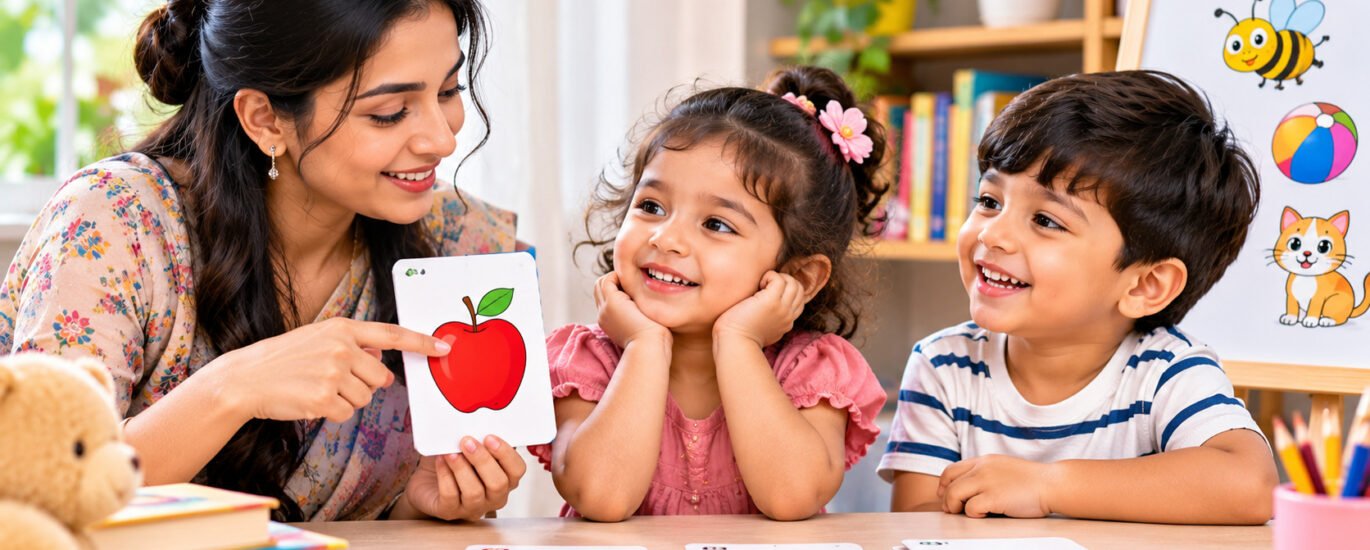
Does your little one point at letters and ask, “What does this say?” That curiosity is the perfect time to introduce phonics. Done playfully, phonics for a 3-year-old and phonics for a 4-year-old can build a strong base for reading without any pressure.
This guide covers what phonics is, what to teach at each age, simple activities to try at home, and when an online class can help.
What Is Phonics?
Phonics is a way of teaching reading by linking letters to their sounds. Instead of memorising whole words, children learn that “s” says /s/, “a” says /a/, and “t” says /t/. When they blend these sounds, they can read the word “sat”.
For young children, sounds matter more than letter names. Saying “sss” for the letter S helps reading more than saying “ess”.
Can a 3-year-old learn phonics?
Yes, but the goal is not reading yet. At 3, phonics is about listening, playing, and noticing sounds. Songs, rhymes, actions, and games prepare the ear for reading later.
Your child may be ready if they:
- Enjoy songs, rhymes and stories
- Name objects in pictures
- Show interest in letters
- Can focus on a fun activity for 5 to 10 minutes
If your child is not interested yet, that is completely fine. Keep sharing stories and rhymes, and try again in a few weeks.
Phonics for a 3-Year-Old: What to Teach
Keep it short, playful, and sound-based:
- Sound awareness. Notice everyday sounds like a doorbell, clapping, or tapping.
- Rhymes. Rhyming trains children to hear sounds inside words.
- First letter sounds. Start with s, a, t, i, p, and n.
- Starting sounds. “Ball starts with /b/.”
- Actions. A movement for each sound makes it easier to remember.
Aim for 5 to 10 minutes a day.
Phonics for a 4-Year-Old: What to Teach
Many 4-year-olds are ready for a little more:
- New letter sounds, such as c, k, e, h, r, m, and d
- Blending simple words like sat, pin, tap and mat
- Hearing the first and last sound in a word
- Tracing and writing letters with fingers, crayons or in sand
- Reading very short sentences with picture support
If your child needs more time with the first few sounds, that is okay. Every child learns at their own pace.
Which Sounds Should You Start With?
Begin with s, a, t, i, p, n. These letters can make many simple words quickly (sat, pin, tap, nap), so your child feels successful early. After that, add c, k, e, h, r, m, and d.
7 Easy Phonics Activities for Home
- Sound hunt. Pick /m/ and find things that start with it, like mug, mat, and mango.
- I spy. “I spy something that starts with /s/.”
- Sand or salt tray. Let your child trace letters with a finger.
- Sound songs. Make a short chant for each new sound.
- Action sounds. Hiss like a snake for /s/.
- Play-dough letters. Shape letters while saying the sound.
- Picture sorting. Sort toys or pictures by their first sound.
How Long Should You Practise?
| Age | Daily practice |
|---|---|
| 3 years | 5 to 10 minutes |
| 4 years | 10 to 15 minutes |
Stop when your child gets tired. A short, happy session works better than a long one.
Common Mistakes to Avoid
- Rushing a child who is not interested
- Teaching only letter names and ignoring sounds
- Turning practice into a test
- Comparing your child with others
- Skipping revision, since young children need to hear sounds again and again
When to Consider an Online Phonics Class
Home practice is a great start. A class can help if:
- You are unsure how to pronounce the sounds correctly
- You want a clear, step-by-step plan
- Your child learns better with a teacher and other children
- There is no good phonics class near you
Choose a class that is short, live, and interactive, where your child speaks and responds instead of only watching.
Phonics at The Reader Nest
Our Jolly Phonics programme for children aged 3+ builds the foundations of reading through letters, sounds, blending, and simple words. Classes are live, interactive, and taught by experienced educators, with flexible timings for families in India and overseas.
Every course starts with a free demo class.
Book your free demo on WhatsApp. Use code TRN10 for 10% off.
FAQ
At what age should a child start phonics?
Many children start around 3 to 4 years, when they enjoy songs, rhymes, and letters. At this age, learning should feel like play.
Can a 3-year-old learn phonics?
Yes, through short activities based on sounds, rhymes, and actions. Reading usually comes later.
What should a 4-year-old know in phonics?
Many 4-year-olds can learn several letter sounds and begin blending simple words, but every child progresses differently.
Should I teach letter names or letter sounds first?
Sounds help with reading more. You can introduce letter names slowly alongside them.
What if my child is not interested?
Take a break and use games, songs, and stories. Interest often returns when learning feels fun.
How long should a phonics session be?
About 5 to 15 minutes, depending on age. Short and positive is best.