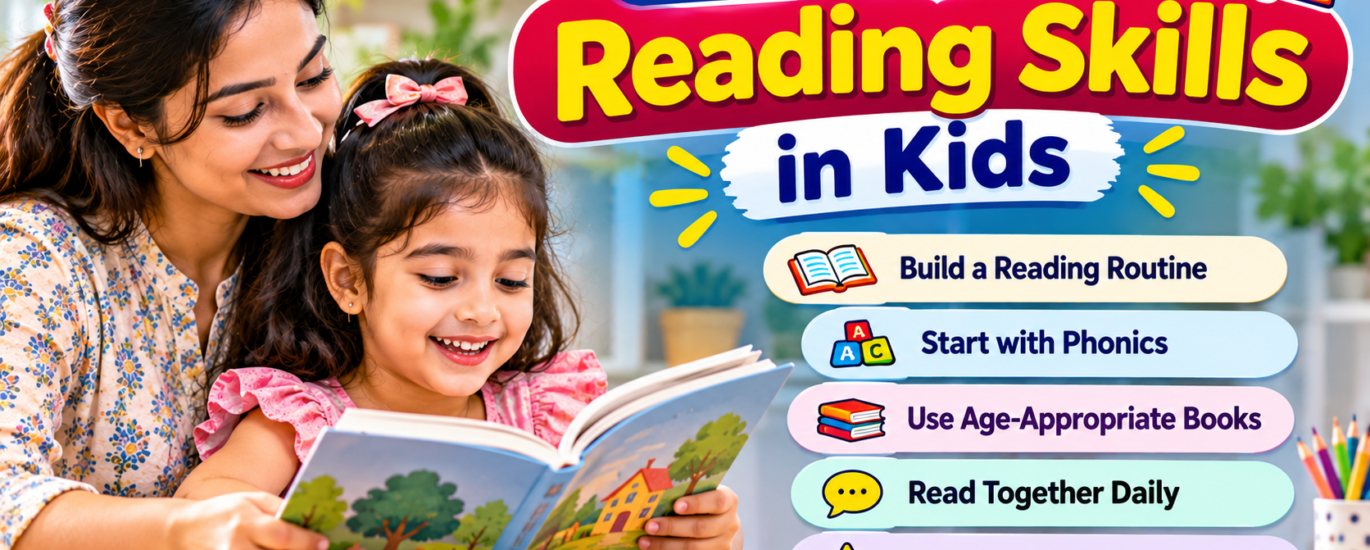
How to improve reading skills in kids. All parents want their children to be confident readers. However, when your child is skipping words, reading slowly or avoiding reading altogether, it can be tricky to know where to start. The good news is reading is a skill which can be developed with the correct support.
how to improve reading skills in kids
Below are 12 tips to help your child develop their reading skills. There are tips based on age ranges, fun activities and an easy to follow daily routine.
What are Reading Skills?
Reading skills involve:
- Phonics – knowing the sounds each letter makes
- Fluency – reading smoothly and at a comfortable pace.
- Vocabulary – knowing what the words mean.
- Comprehension – knowing what you have read.
- Engagement – wanting to read.
If your child is struggling to read, identifying where they need support would be helpful.
Why may some children struggle to read?
There are a variety of reasons why children struggle to read but most can be overcome:
- They lack phonics knowledge.
- They have a limited vocabulary.
- They aren’t exposed to many books at home.
- They lack confidence or are afraid to make mistakes.
- They struggle to concentrate.
- The reading level is too challenging or boring.
Whilst some children may need additional support from teachers or experts, most children will benefit from having simple routines in place.
12 Tips to Improve Reading Skills in Children
1. Focus on Phonics
Teaching your child about phonics means they will know that each letter makes a specific sound and can be combined to form words. If your child is guessing then they will benefit from revisiting phonics. They will be able to figure out new words.
2. Read Aloud Everyday
Even just 10-15 mins of reading to your child will help them develop their vocabulary, listening skills and a love for stories. Change your voice, pause to ask questions and allow them to turn the pages.
3. Let your child pick what they read
Children will read more if they can choose what they are reading! Whether they like dinosaurs, animals, cars or fairytales it doesn’t matter, they need to be interested.
4. Ensure the book level is appropriate
Children can get frustrated if they are reading something too challenging. They won’t develop if the book is too easy. If your child is struggling to read more than a couple of words per page then it is likely the book is too challenging.
5. Short & Regular Sessions
It is better to read for 10 minutes a day rather than one long session at the weekend. This will help your child develop their fluency.
6. Set a Comfortable Time
Set a time everyday to read. Maybe after dinner or before bed. Switch off the TV and phones and create a cosy space with cushions and good lighting.
7. Shared Reading
Take turns to read a page or read a sentence together. This will help your child with their fluency.
8. Ask Questions
Ask simple questions to help them with comprehension:
- What do you think will happen next?
- Who was your favourite character?
- Why did the character do that?
- What was your favourite part?
9. Build Vocabulary
Explain new words simply and use them in everyday conversations. Play word games and talk about items, places and feelings.
10. Praise Efforts
Instead of just correcting them say “I like how you tried that word” This way children will feel safe to make mistakes.
11. Be a Reading Role Model
Children will imitate behaviours. If you are reading a book, newspaper or magazine then they will learn reading is important.
12. Reduce Screen Time
Ensure there are books available in the living room, bedroom and car. Reduce screen time and encourage your child to read.
Top Tips by Age Range
| Age Range | Tip |
|---|---|
| 3-4 years | Focus on rhyming, picture books, letter sounds and listening games. |
| 5-6 years | Focus on blending, simple words, short sentences and sight words. |
| 7-8 years | Focus on fluency, longer stories, vocabulary and simple questions. |
| 9-10 years | Focus on comprehension, discussion, chapter books and enjoying reading. |
10 Fun Reading Activities
- Sound Scavenger Hunt – Find items that begin with a certain sound.
- Word Scavenger Hunt – Hide word cards around your house and read them as you find them.
- Retell the story – Ask your child to retell the story.
- Draw the story – After reading ask your child to draw their favourite part.
- Rhyming Game – Think of words that rhyme with cat, sun or ball.
- Word Cards – Use letter cards to create simple words.
- Reading Tracker – Add a sticker for every book they finish.
- Family Reading Time – Everyone reads together for 15 mins.
- Mini Book – Ask your child to write and illustrate a short story.
- Puppet Reading – Read to your soft toy/puppet. This reduces the pressure.
Simple Daily Routine (20 Mins)
| Time | Activity |
|---|---|
| 5 mins | Quick phonics/sight words recap |
| 10 mins | Reading a book together |
| 3 mins | Discuss the story |
| 2 mins | Quick word game |
You can adapt the times but keep it short and positive.
Things to Avoid
- Forcing your child to read when they are tired or upset.
- Correcting them constantly.
- Comparing them to siblings/peers.
- Using books that are too challenging.
- Not using phonics and sight words.
- Making reading a punishment.
- Expecting quick results.
When to Seek Additional Support
Talk to your child’s teacher or reading expert if:
- They are reading much slower than their peers despite regular practice.
- They are frequently getting their letters and sounds mixed up.
- They are avoiding reading or getting very upset.
- They are struggling to remember simple words.
- You have concerns about their concentration or learning difficulties.
The sooner your child receives support the better chance they have of developing their confidence and catching up.
How Online Reading Classes Can Help
If you are finding it difficult to practice reading at home then live online classes can provide structure and expert support. A good class will have:
- A clear structure (Phonics, Words & Sentences)
- Small groups so your child can talk.
- Fun games, stories & activities.
- Regular parental feedback.
Reading Classes at The Reader Nest
Our live online classes will help your child develop strong foundations in Phonics, Reading, English & Hindi. Our programme for children aged 3+, Jolly Phonics will help your child begin to read with letter sounds, blending and simple words. The classes are interactive and delivered by experienced educators. We offer flexible times to suit families in India and overseas.
All our courses include a free demo class.
Book your free demo on WhatsApp. Use code TRN10 for 10% off.
FAQs
How can I improve my child’s reading skills at home?
Read aloud everyday, let them choose books, practice phonics, ask questions and keep sessions short & fun.
How long should they read for?
Most children should aim to read for 15-20 mins. Younger children can read for 10 mins.
Why isn’t my child interested in reading?
They may be reading books that are too challenging, too boring or not matching their interests. Try different topics, shared reading and keep sessions relaxed.
What age should a child start reading?
Many children will begin to read simple words between the ages of 4-6. However, every child is different. Starting with listening, rhyming and phonics games will help.
What if my child is guessing words?
They will benefit from going back to phonics. Encourage them to look at the letters and slowly sound them out. Cover the picture if they are guessing.
Are apps and videos helpful?
They can be helpful but shouldn’t be used instead of actual books. Keep them to a minimum.
When should I be worried?
If your child is struggling greatly, avoiding reading or consistently getting their letters mixed up then talk to their teacher or an expert.