Phonics Sounds Chart with Pronunciation: All 42 Sounds Explained If you are introducing your child to phonics, one of the first things parents often ask is what sounds to teach and how to pronounce them. Many parents are surprised to find out that there are more than just 26 sounds in the English language!
This guide will give you a full breakdown of phonics sounds, including helpful tips on pronunciation, examples, and order.
What is a phonics sounds chart?
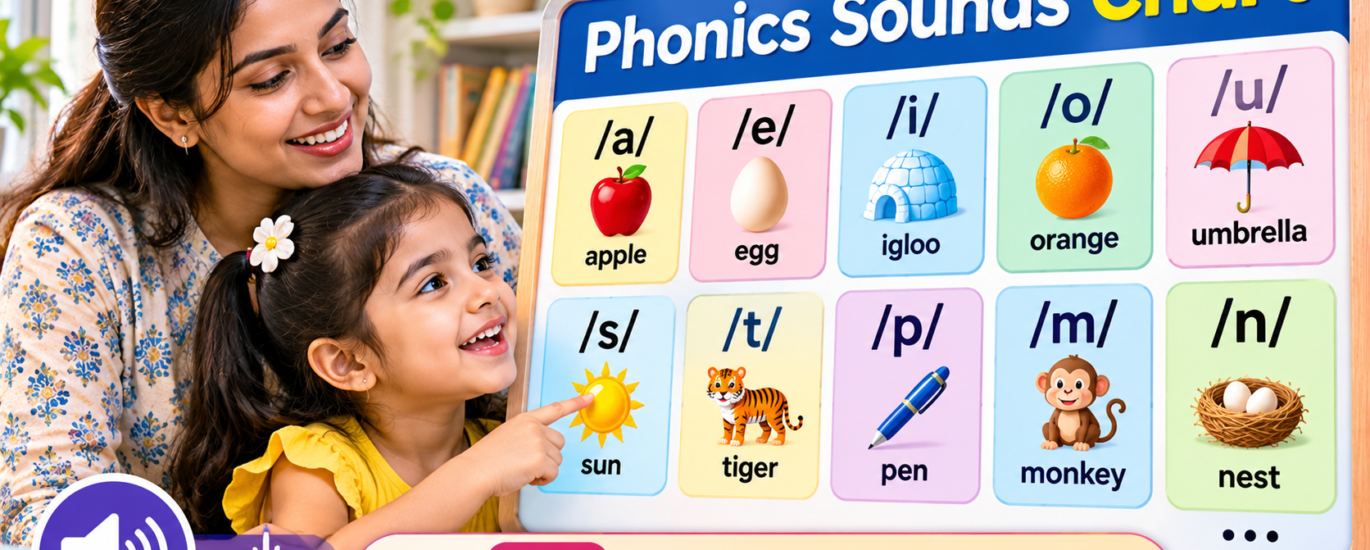
A phonics sounds chart gives a list of all sounds used in English. They show which letters match the sounds, along with examples. This helps parents and children understand how letters and sounds link together.
There are 42 main sounds in English. These can be single letters (such as s, a and t) or double letters (such as sh, ch and ai). Double letters are known as digraphs.
Letter Sounds vs Letter Names
The letter S has the letter name ‘ess’. However, when reading, children use the sounds, not the names! So phonics focuses on sounds.
42 Sounds & Order
Phonics sounds are usually taught in small groups. The easiest letters to begin with are those which produce lots of simple words. Below is the order used in Jolly Phonics.
Group 1: s, a, t, i, p and n
| Letter | Sound | Example |
|---|---|---|
| s | /s/ | sun |
| a | /a/ | apple |
| t | /t/ | tap |
| i | /i/ | insect |
| p | /p/ | pen |
| n | /n/ | nut |
Group 2: c/k, e, h, r, m and d
| Letter | Sound | Example |
|---|---|---|
| c/k | /k/ | cat, kite |
| e | /e/ | egg |
| h | /h/ | hat |
| r | /r/ | rat |
| m | /m/ | mat |
| d | /d/ | dog |
Group 3: g, o, u, l, f and b
| Letter | Sound | Example |
|---|---|---|
| g | /g/ | goat |
| o | /o/ | orange |
| u | /u/ | umbrella |
| l | /l/ | leg |
| f | /f/ | fan |
| b | /b/ | ball |
Group 4: ai, j, oa, ie, ee and or
| Letters | Sound | Example |
|---|---|---|
| ai | /ai/ | rain |
| j | /j/ | jam |
| oa | /oa/ | boat |
| ie | /ie/ | pie |
| ee | /ee/ | tree |
| or | /or/ | fork |
Group 5: z, w, ng, v, oo (short) and oo (long)
| Letters | Sound | Example |
|---|---|---|
| z | /z/ | zip |
| w | /w/ | web |
| ng | /ng/ | ring |
| v | /v/ | van |
| oo (short) | /oo/ | book |
| oo (long) | /oo/ | moon |
Group 6: y, x, ch, sh, th (soft) and th (voiced)
| Letters | Sound | Example |
|---|---|---|
| y | /y/ | yes |
| x | /ks/ | box |
| ch | /ch/ | chip |
| sh | /sh/ | ship |
| th (soft) | /th/ | thin |
| th (voiced) | /th/ | this |
Group 7: qu, ou, oi, ue, er and ar
| Letters | Sound | Example |
|---|---|---|
| qu | /kw/ | queen |
| ou | /ou/ | cloud |
| oi | /oi/ | coin |
| ue | /ue/ | blue |
| er | /er/ | her |
| ar | /ar/ | car |
Pronunciation Tips
It is important that the sounds are pronounced clearly, as children will copy what they hear.
- Short and clear – Pronounce /b/ and /m/, not buh and muh.
- Don’t add an ‘uh’ sound to the end. This makes blending sounds harder. Make sure you aren’t saying cuh-a-tuh, as it won’t sound like cat.
- Long sounds – Try to stretch the sounds. /s/, /m/, /f/ and /n/ can be stretched (sss, mmm, fff, nnn).
- Short sounds – Sounds like /t/, /p/, /k/, and /d/ can’t be stretched. Make sure you say them quickly.
- Mouth movements – Try to show your mouth moving. Let your child watch your lips and tongue move, or try using a mirror.
Common Confusions
| Confusion | What to do |
|---|---|
| b and d | Teach separately. Use images (ball and dog). |
| p and b | Use your hand to feel the air for /p/ and your voice for /b/. |
| m and n | /m/ brings your lips together. /n/ keeps them apart. |
| sh and ch | /sh/ should be quiet. /ch/ should be like sneezing. |
| th (2 types) | Show your tongue between your teeth. |
Using the Sounds Chart
- Start with group 1. Teach one or two sounds at a time.
- Say, show, and act. Say the sound, show the letter, and point to an image. Add an action.
- Review daily. Spend a minute going over previously learned sounds.
- Blending. Once your child knows a few sounds, start blending them.
- Take it slow. Only move on to the next group when you feel confident with the previous sounds.
Fun Activities to Practice
- Sound Scavenger Hunt. Find items around the house that start with the sound.
- Flashcards. Use flashcards and see how many your child can say in a minute.
- Sound Bag. Pick out an item and say the starting sound.
- Jumping. Place letters on the floor and jump to the one you say.
- Mirror. Watch your mouth move.
Do accents affect the sounds?
Yes slightly. Some sounds are said slightly differently in British, American, and Indian English. This is fine! The most important thing is to pronounce them clearly and consistently. Your child’s teacher at school should use the same method.
When should I consider a phonics class?
Whilst a sounds chart is a great resource, it isn’t interactive and won’t talk to your child. A class could help if:
- You aren’t confident with how to pronounce some sounds.
- Your child gets confused with similar sounds.
- You want a clear step-by-step programme.
- It is difficult to practice regularly at home.
Find a live interactive class where your child can talk and will receive gentle corrections.
Phonics Classes with The Reader Nest
Our Jolly Phonics classes for children aged 3+ will teach the basics of reading. We use letters, sounds, blending, and simple words. Our classes are live, interactive, and taught by experienced educators. We offer flexible timings to suit busy families in India and overseas.
All our classes offer a free demo class to start with.
Book your free demo on WhatsApp using code TRN10 for 10% off.
FAQ
How many phonics sounds are there in English?
There are around 44 sounds in English. The Jolly Phonics programme teaches 42 main sounds. These include single letters and double letters (sh, ch and ai).
What phonics sounds should I teach first?
Most programmes start with s, a, t, i, p and n as they create lots of simple words quickly.
Should I teach my child letter names or letter sounds?
Start with letter sounds as they will help your child read. Letter names can be introduced slowly.
Why shouldn’t I add an ‘uh’ sound?
Adding an ‘uh’ (buh instead of b) will make blending harder. By keeping your sounds short and clear, your child will be able to read words like bat easily.
What is a digraph?
A digraph is when 2 letters make 1 sound. For example, sh, ch, th, ai, and ee.
At what age can children learn all 42 sounds?
This depends on the child. Many children will slowly learn the sounds over a few months in small groups. They will also be regularly reviewed.
Do I need a printed chart?
A printed chart can be useful for quick review. Place it somewhere your child can see and point to the sounds whilst practicing.