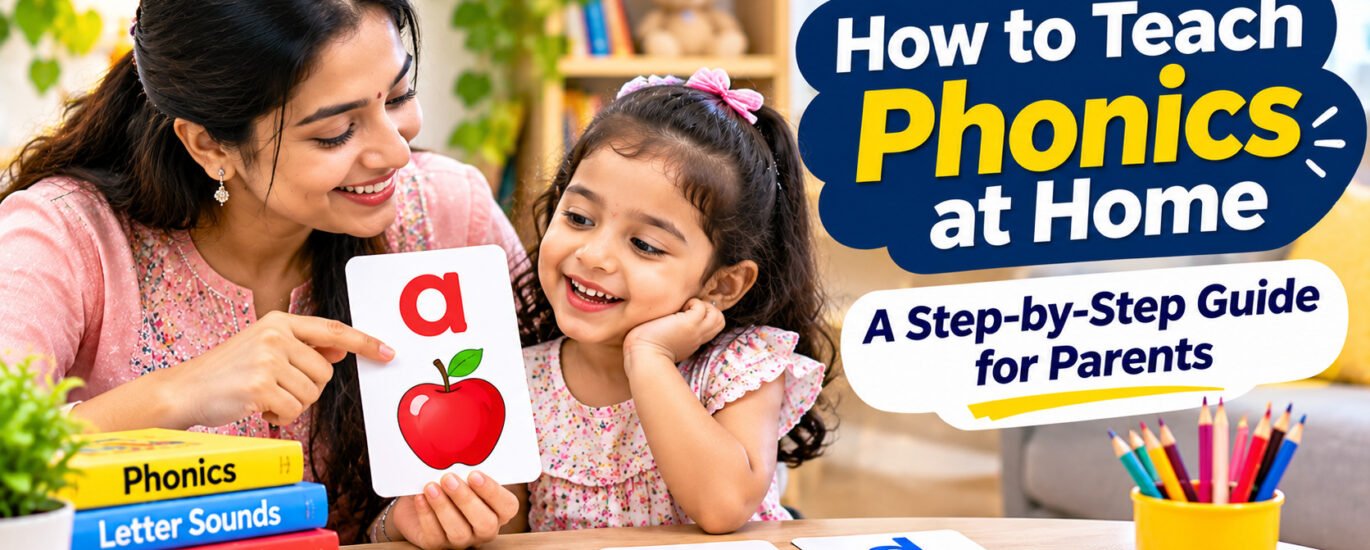
How to teach phonics at home Learning phonics doesn’t have to be done by teachers. Just using a clear system, taking a few minutes a day and having lots of fun will allow your child to learn phonics at home!
This guide will show you how to get started, in which order to teach them, how to set up your sessions and what to do if they struggle.
What is Phonics?
Phonics is a way of teaching children to read by showing them the relationship between letters and sounds. Once your child knows the correct sounds they can blend them together to read words. For example /c/ /a/ /t/ = Cat
It helps children learn to decode new words independently.
Before you start
- We know that sounds should be taught rather than letter names. So teach sss instead of ess
- Short sessions are best! 10-15 minutes is perfect
- Every child learns at their own speed. Don’t compare
- Have fun! If it feels like a test change up the activity
1. Learning to listen
Before teaching letters help your child to recognise sounds. Here are some ideas:
- Sing nursery rhymes
- Clap out the rhythm in their names and words
- Play ‘What can you hear?’ using sounds from around the house
- Read rhyming picture books
Children who can recognise sounds will find it much easier to link them to letters.
2. Teaching initial letter sounds
These are the first few sounds that will create lots of simple words:
s, a, t, i, p, n
Teach one or two sounds at a time. For each sound:
- Model the sound clearly
- Show the letter
- Use a picture (sun)
- Add a movement (hissing like a snake for /s/)
Repeat frequently. Only teach new sounds once your child can remember the previous ones.
3. Learning to pronounce sounds
Pronounce the sounds clearly and try not to add in the ‘uh’ sound. For example say /s/ instead of suh and /m/ instead of muh. This will make blending much easier.
If you’re unsure have a quick video of a teacher modelling the sounds and practise yourself.
4. Blending
Blending is when we put sounds together to make a word.
- Show them the word ‘sat’
- Say the sounds clearly /s/ /a/ /t/
- Put them together smoothly sss-aaa-t
- Say the word sat
Use simple words like sat, pin, tap and nap. Let your child blend them together as soon as they’re confident.
5. Practicing writing
This will help them to remember. However, make sure they’re writing after learning the sounds.
- Draw the letters in sand/salt/flour
- Start with your finger then use a crayon/pencil
- Make the letters with play-dough
- Say the sound whilst writing
Don’t worry about making them neat.
6. Introducing simple words and sentences
Once your child can blend simple words introduce:
- More sounds c, k, e, h, r, m, d
- Simple CVC words (3 letter words) cat, hen, sun, hop
- Very simple sentences A cat sat.
- Common tricky words the, is, said.
Keep books simple and based around the sounds they know.
A simple routine (15 minutes)
| Length | Activity |
|---|---|
| 2 mins | Quick recap of known sounds |
| 3 mins | Teach 1 new sound |
| 4 mins | Blending simple words |
| 3 mins | Writing/tracing |
| 3 mins | Fun game |
You can adapt the order but keep it short and positive.
8 Easy Phonics Games
- Sound Scavenger Hunt – Find objects that start with the sound
- I Spy – Use the sounds instead of letter names.
- Sound Bag – Pick an object out and say the first sound.
- Flashcards – Show flashcards and see how many they can say in a minute.
- Jumping – Put letters on the floor and jump to the ones you say.
- Word Builder – Use letter cards to build simple words.
- Treasure Hunt – Hide word cards around the room to find and read.
- Playdough Words – Make the letters and blend.
What will you need?
Not much! To start with you’ll need:
- Picture books
- Letter cards (made by you!)
- Sand/salt/flour tray
- Playdough
- Objects from around the house.
Having printed worksheets can be useful later once they know a few sounds.
Common problems and solutions
They forget the sounds quickly.
This is normal! Have a quick recap each day, use movements and revisit previous sounds.
They mix up similar letters (b and d).
Take extra time to teach them individually, use pictures and movements and don’t teach them together.
They get bored.
Keep the sessions short, change the activity or make it a game. Take a break.
They guess the words.
Gently cover the picture and ask them what sounds they can see. Encourage them to blend them slowly.
I’m unsure how to pronounce the sounds.
Practice the sounds yourself. Alternatively look for a class where a trained teacher can model the sounds.
Things to avoid
- Too many sounds
- No recapping
- Only teaching letter names
- Being too harsh with corrections
- Long sessions
- Comparing to other children.
How long will it take to learn phonics?
This depends on how old your child is, how interested they are and how often you practise. Many children will be able to blend simple words after learning their initial few sounds. However, every child will learn differently. It’s more important to practise regularly with short sessions and lots of encouragement.
When should I consider a phonics class?
Whilst learning at home is brilliant, you might want to consider a class if:
- You’re unsure how to pronounce the sounds
- You’d like a clear and structured programme
- Your child enjoys learning with a teacher and other children
- It’s difficult to practise regularly at home.
Try to find an interactive class. Your child will be able to talk and interact.
Phonics at The Reader Nest
Our Jolly Phonics programme for children aged 3+ teaches the basics of reading using letters, sounds, blending and simple words. Our classes are interactive and live with experienced educators. We offer flexible times to suit busy families in India and abroad.
All courses have a free demo class.
Book your free demo on WhatsApp using code TRN10 for 10% discount.
FAQ
How can I teach phonics at home?
Start with some listening games, teach a few letter sounds, practice blending simple words and keep sessions short and fun.
What age can I start teaching phonics?
Many children will be ready between 3-4 years old as they love singing, rhyming and letters. You can start with listening games with younger children.
How long should I spend teaching phonics?
Around 10-15 minutes. For younger children 5-10 minutes is fine.
What sounds should I start with?
Many programmes start with s, a, t, i, p and n as they make lots of simple words quickly.
Do I need anything special?
No! All you’ll need is picture books, letter cards (you can make these!), sand, playdough and objects from around the house.
Should I teach letter names or sounds?
Teach sounds first as they will help with reading. You can gradually introduce letter names.
My child isn’t learning quickly enough.
Every child learns at their own pace. Slow things down and have more recaps. Keep it fun!